Share Our Shores
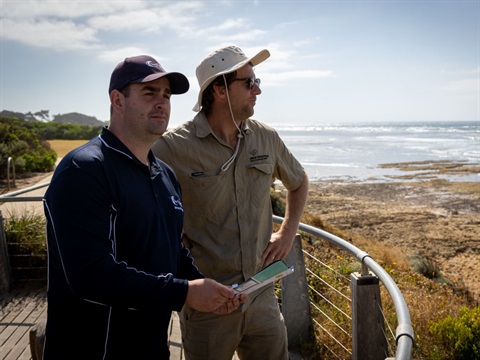
Together with Surf Coast Shire Council, we have joined forces with a simple message for all beachgoers who visit and enjoy our coast each Summer.
From the start of the Surf Coast at Torquay, right along the coast to Lorne, we are asking beachgoers to ‘Share Our Shores’.
This important initiative focuses on joint patrols that improve amenities, public safety and the environmental protection of our coastal reserves and beaches.
It is great to be working alongside our friends at Surf Coast Shire Council to spread the message to respect the coast and respect other beach users.
Surf Coast Shire and the Great Ocean Road Coast and Parks Authority wish to work together to improve amenity and public safety of beaches and foreshore reserves in the municipality, throughout the year but particularly during peak season and on selected public holidays.
By working together on joint patrols we aim to increase compliance with Council laws and the Authority’s regulations over coastal reserves.
Key priorities for the patrols include enforcement of dog walking regulations, illegal camping, litter, public safety, wildlife and environmental protection.
We will work together to ensure safe and equitable access to foreshore facilities like the Fishermans Beach boat ramp, as well as enforcing the beach closure at Demons Bluff Anglesea.
How we conduct joint patrols
Patrols will consist of one Surf Coast Shire Ranger and one Authority Ranger working together on agreed routes and hours either on foot or from an all-terrain patrol vehicle.
Key Messages
Dogs
- Your dog can negatively impact the coastal environment in a number of ways that you may not be aware of. Off lead dogs disrupt wildlife such as seals and seabirds whilst nesting, resting and feeding and can reduce threatened Hooded Plover breeding success by 50%.
- Uncontrolled dogs also damage coastal vegetation and erode fragile dunes.
- Failure to pick up dog waste ruins our pristine environment for other beach goers and the added nitrogen encourages weed and algal growth impacting on the coastal ecosystem.
- Even ‘friendly dogs’ scare others who see them as out of control. Many ‘no dog, timeshare and dog on lead’ beaches are frequented by families with beach-goers who wish to enjoy the beach without worrying about dogs.
- There are possible infringements for failing to pick up after your dog, for dogs not under effective control, and dogs off lead in no dog or timeshare zone.
Horses
- Horses may be ridden with a permit at Pt Impossible / Whites beach and Fairhaven but riders must keep well below high tide line, must not gallop and must consider the safety of other beach users.
- Horse droppings must be cleaned up by the rider on any pathways.
Litter
- It has been estimated that over 8 million tons of plastic litter enters the world’s oceans every year.
- Litter and particularly plastics and micro plastics kill marine creatures such as fish, birds and mammals.
- The Authority and Surf Coast Shire have a ‘Plastic Wise Markets and Events’ policy that bans all single use plastics from events. The Authority aims to foster a culture of sustainable and responsible litter practices.
- Placing rubbish outside bins is a littering offence under the EPA Act (2007), fines for littering range from $370 – $740 dollars.
- Keep our beaches clean – if this bin is full, please take your rubbish with you.
Dune protection and vegetation damage
- Our delicate coastal dunes and vegetation make the Surf Coast environment a beautiful place to visit and provide a home for our local native animals.
- Dunes are fragile - walking, sliding or playing on the dunes contribute to erosion that is very difficult to repair.
- Many dune areas contain Aboriginal shell middens that are protected by law and of high cultural significance to the local Rights Holders.
- All native plants are protected by law and under the Surf Coast Shire planning scheme illegal vegetation removal will incur fines.
- Entering fenced conservation areas is an offence under the Crown Land Reserve Regulations.
Public Safety
- The launch and retrieval of boats is difficult and can be dangerous especially for swimmers in the area.
- Swimming is not permitted within 50m of a boat ramp when the ramp is in use, and children must be kept well clear of boat ramps.
- Four-wheel drive vehicles may only be driven on the beach within 50m of the boat ramp to launch and retrieve a vehicle. They must not be parked on the beach.
- The Surf Coast is a high bushfire danger area. Fires and charcoal burners can start bushfires, especially on windy days. Lighting of fires is not permitted on coastal reserves at any location. Charcoal burners are not allowed on total fire ban days - on the spot fines for having a fire on a total fire ban day can be over $2000.
- ‘Hero shots’ (where people put themselves at an unacceptable risk in the pursuit of a photo) on cliffs or roadways are very dangerous for the participants and other community members. We encourage people to stay inside safety fencing at all times.
- Smoking and consumption of alcohol is not allowed on Surf Coast beaches.
- Under the Crown Land Reserve Act (1978) beach umbrellas are only allowed if an anchoring device is fitted, beach sun shelters are allowed, however gazebos and marquees are not permitted without a permit.
- The beach at Demons Bluff (also known as Grinders) to the west of Anglesea Family Caravan Park is permanently closed. This decision was based on the significant public safety risks that landslides pose along this section of cliffed coastline.
- Coastal cliffs are dynamic and can collapse without warning. Cliff collapses, also known as cliff failures, occur when the internal strength of the formation is reduced beyond a threshold where it can no longer support its weight.
- Cliff collapses can occur when the cliff is exposed to erosion by the ocean, changes in cliff moisture content, extremes of heat and cold, large rainfall events and erosive runoff and seismic activity.
- When visiting areas with coastal cliffs remember to steer clear of cliffs and caves, stay on established tracks at all times, seek the signs and follow official guidance and share the word and warn others of the risks.
- Stay away from cliffs and caves, stick to established tracks, see the signs and follow guidance and share the word and warn others.
Illegal camping and sleeping in cars
- Sleeping in cars and illegal camping often leads to littering, spoils public amenity and is a general nuisance for residents and holiday makers.
- Camping and sleeping in vehicles is only allowed in designated camping areas along the Surf Coast. There is no permitted sleeping in cars or camping in any beach car parks.
- Illegal camping and sleeping in cars is an offence under Surf Coast Shire laws - this carries an on the spot fine.
- Accommodation is available can be booked through the Authority’s website.
Wildlife offences
- Seals, penguins and a variety of seabirds use the Surf Coast to rest, feed and breed. Please keep well clear and ensure that your dog does not rush, attack, bite, worry or chase them, all of which are offences under the Wildlife Act (1975).
- Under the Wildlife Act (1975) it is an offence for a person to approach within 30m of a resting seal, and it is an offence for a dog to approach within 50m of a resting seal.
- Taking, destroying or disturbing wildlife is an offence and the taking or destroying of threatened wildlife such as hooded plovers, carries a maximum penalty of up to two years jail time.
- Recreational boats must remain 100 metres away from dolphins, except if approached. Beach goers can allow the dolphins to approach by choice, but must leave them alone if the dolphins avoid humans.